
Bulloch County Criminal Court Cases
Bulloch County belongs to the Ogeechee Judicial Circuit. Superior Court hears felony prosecutions. State Court hears misdemeanors and state-law traffic matters. Municipal courts in Statesboro, Brooklet, and Portal retain ordinance and qualifying traffic cases, so those files may never enter the county felony docket. Juvenile Court uses a separate division, and its records are generally restricted.
The Clerk of Superior, State and Juvenile Court maintains the county prosecution files. A clerk’s case file is not an arrest report. It shows the accusation or indictment prosecutors filed, later motions and hearings, the plea or trial, the outcome for each count, and the court’s sentence. The sheriff holds arrest and jail material, while the district attorney screens and prosecutes referrals. Neither replaces the clerk as the record custodian.
One Clerk for Bulloch Courts
The Bulloch County Clerk of Courts lists Heather Banks McNeal as the elected clerk. The office is at 20 Siebald Street, Statesboro, GA 30458. Its telephone number is 912-764-9009, fax is 912-764-5953, and records email is clerkinfo@bullochcounty.net. A requester should provide the full name, case number, book and page when relevant, and contact details. The office states that email requests are processed in three to five business days.
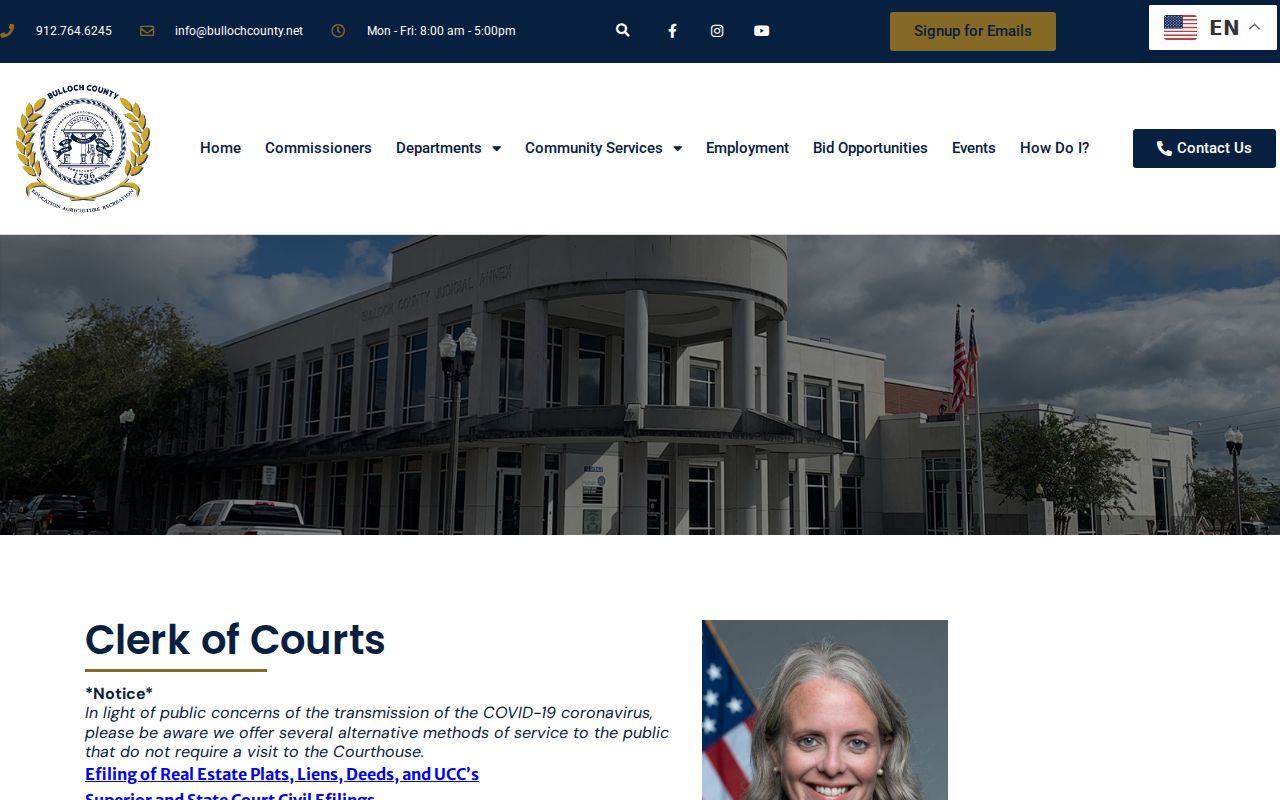
The clerk page is also the fallback for older, archived, or non-digitized cases. An empty web result does not prove that no case exists. Ask staff to check the correct court index and explain whether the file can be inspected, copied, or certified. Plain copies are listed at $0.50 and certified copies at $2.50, but confirm that the listed charge applies to the exact criminal document requested.
Searching Bulloch County Case Records
Georgia has no single complete, free statewide trial-court docket. The Georgia Judicial Gateway and E-Access to Court Records routes readers to participating systems. Bulloch County also links PeachCourt for Superior and State Court access. PeachCourt places searching behind registration and login, with Email and Password fields, Sign In, registration, and password-recovery controls. When online coverage is unclear, the clerk’s email and counter remain the sound route.
- Choose Superior Court for a felony or State Court for a misdemeanor or state traffic case.
- Use the case number when known; otherwise supply the complete name and enough detail to separate similar records.
- Check the filing year, court division, and case type before opening a result.
- Read the docket, charging paper, outcome for each count, and signed sentencing order together.
- Ask the clerk for a plain or certified copy when the online image is missing or formal proof is needed.
| Search or Request Field | Format | Use | Limit |
|---|---|---|---|
| Email and password | Login fields | Open PeachCourt account access | Search controls are account-gated |
| Case number | Text | Find one indexed case | Must match the court’s format |
| Party name | Text | Search when the number is unknown | Common names need more detail |
| Court and filing year | Filter or request detail | Narrow the correct docket | Municipal files remain separate |
| Book and page | Clerk request detail | Help retrieve an indexed document | Applies only when known |
Bulloch Criminal Court Jurisdiction
The charge level determines the proper counter. Superior Court handles felonies and other matters within superior jurisdiction. State Court handles misdemeanors and state traffic cases. Municipal courts keep their own ordinance and qualifying traffic cases. Juvenile Court records use stricter access rules. A city citation may therefore be real even when it does not appear in the Superior or State Court search.
The Bulloch County judicial directory lists the local judicial offices and four Superior Court judges: Chief Judge Michael Muldrew and Judges Lovett Bennett Jr., Ronald K. Thompson, and Matthew K. Hube. Court assignments can change, and chambers are not record counters.
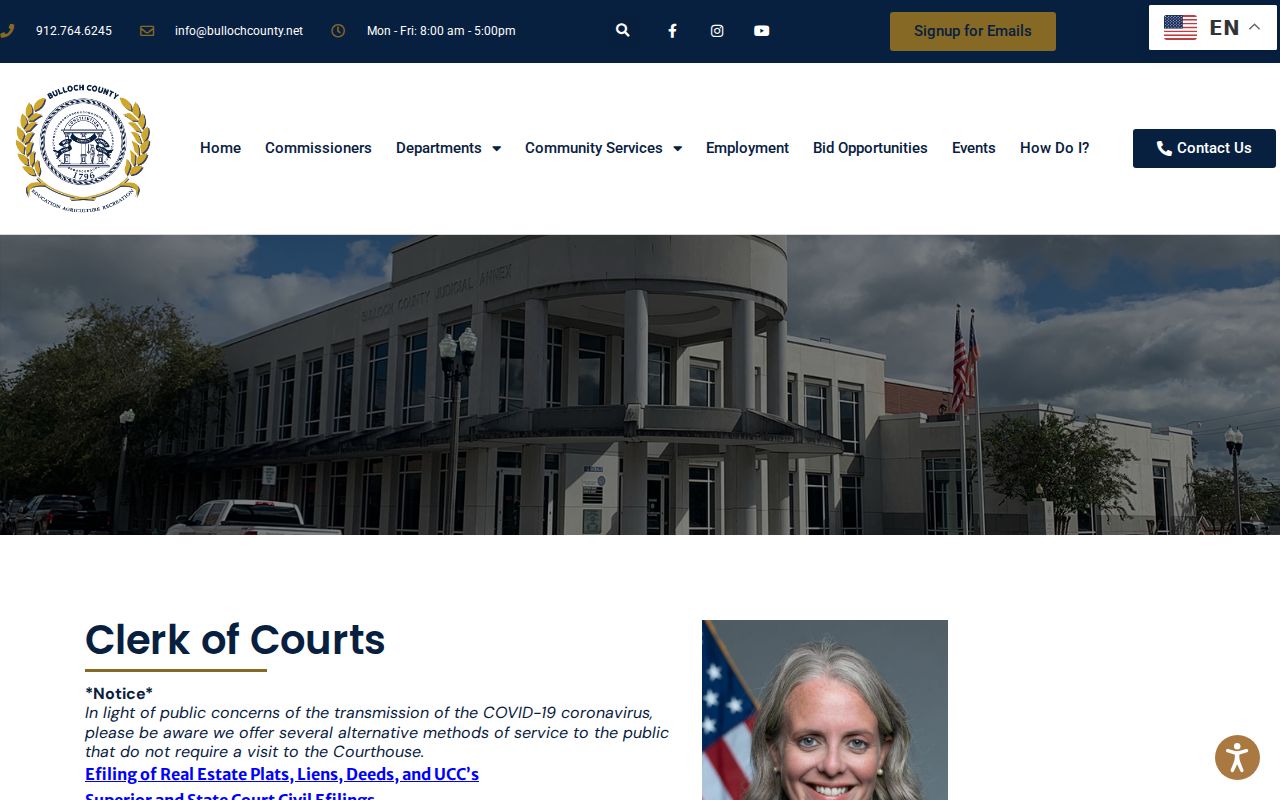
The directory helps identify the court, but docket and copy requests still go to the clerk. Contact a municipal court directly for its own city file rather than asking the nearest county counter.
Location can also cause confusion. The historic 1894 courthouse is the downtown landmark, but the modern Judicial Annex across Siebald Street holds the clerk’s public-record operation. Bulloch County once held court in homes, built an early wooden courthouse, lost a later building during the Civil War, and expanded again when court and record space tightened in the 1990s. That history explains why a visitor should confirm the correct entrance before traveling. The clerk warns that entry can include a metal detector or wand and inspection of bags. Phones must be off in courtrooms, and food, beverages, gum, and tobacco are barred there.
Inside a Bulloch County Case File
A public Bulloch County criminal case file can show the case number, court and division, filing date, status, displayed defendant name, attorneys, filed charge and statute, accusation or indictment, hearing dates, motions, plea, disposition, sentence, bond, financial entries, and indexed documents. Exact online visibility depends on the system. Sensitive identifiers, victim and minor data, sealed documents, and protected attachments may be withheld or redacted.
| Case Number & Court | Identifies the file and the division that holds it. |
|---|---|
| Charging Document | The accusation or indictment states what prosecutors formally pursued. |
| Docket Entries | A dated index of filings, hearings, orders, and other activity. |
| Hearing Dates | Scheduled and completed appearances, subject to later changes. |
| Disposition & Judgment | The outcome for each count, not merely a broad case label. |
| Sentence & Conditions | Custody, probation, fines, and other terms in the signed order. |
For case research, the charging paper, disposition, and sentence are often the most useful documents. The docket connects them by date. A financial entry alone does not explain guilt, and an upcoming hearing does not establish the final result.
Reading Bulloch Criminal Case Outcomes
Georgia outcome terms have distinct meanings. A nolle prosequi means the prosecutor formally chose not to proceed with a charge at that time. A dismissal ends a charge without conviction. An acquittal is a not-guilty result after adjudication. A no bill means the grand jury declined the proposed indictment. First Offender treatment may avoid an adjudication of guilt after successful completion, but it is not an acquittal or a literal deletion of every record.
Read the entry beside each count, then locate the signed order. One case can contain several charges with different outcomes. The booking allegation can also differ from the later accusation or indictment. If a courthouse file shows a final disposition that is absent from a GCIC response, obtain a certified copy and use the Georgia Bureau of Investigation’s correction or update route.
How a Bulloch Criminal Case Moves
An arrest or citation begins the local trail, but the prosecutor decides what charge to pursue. A felony may proceed by accusation where lawful or by grand-jury indictment. At arraignment, the filed charge is stated and a plea is entered. Discovery, motions, and pretrial hearings follow. A negotiated plea, dismissal, or trial leads to a disposition, then a sentence where applicable. An appeal may add a later court record.
Case flow: Charges Filed › Arraignment › Pretrial › Plea or Trial › Disposition › Sentencing
Timing varies by custody, complexity, court calendar, motions, and other case facts. No single public page supplies a reliable duration for every Bulloch prosecution. Check the current docket and hearing notices rather than estimating from the arrest date.
Certified Bulloch Court Dispositions
A plain copy is suited to reading and routine research. A certified copy bears the clerk’s certification and is the better choice when a person must prove what the court decided or correct their own state history. Ask for the final disposition and sentencing order by name. A stack of docket entries may not provide the same clear proof.
The Georgia Superior Court Clerks’ Cooperative Authority supports statewide clerk services and electronic access layers.
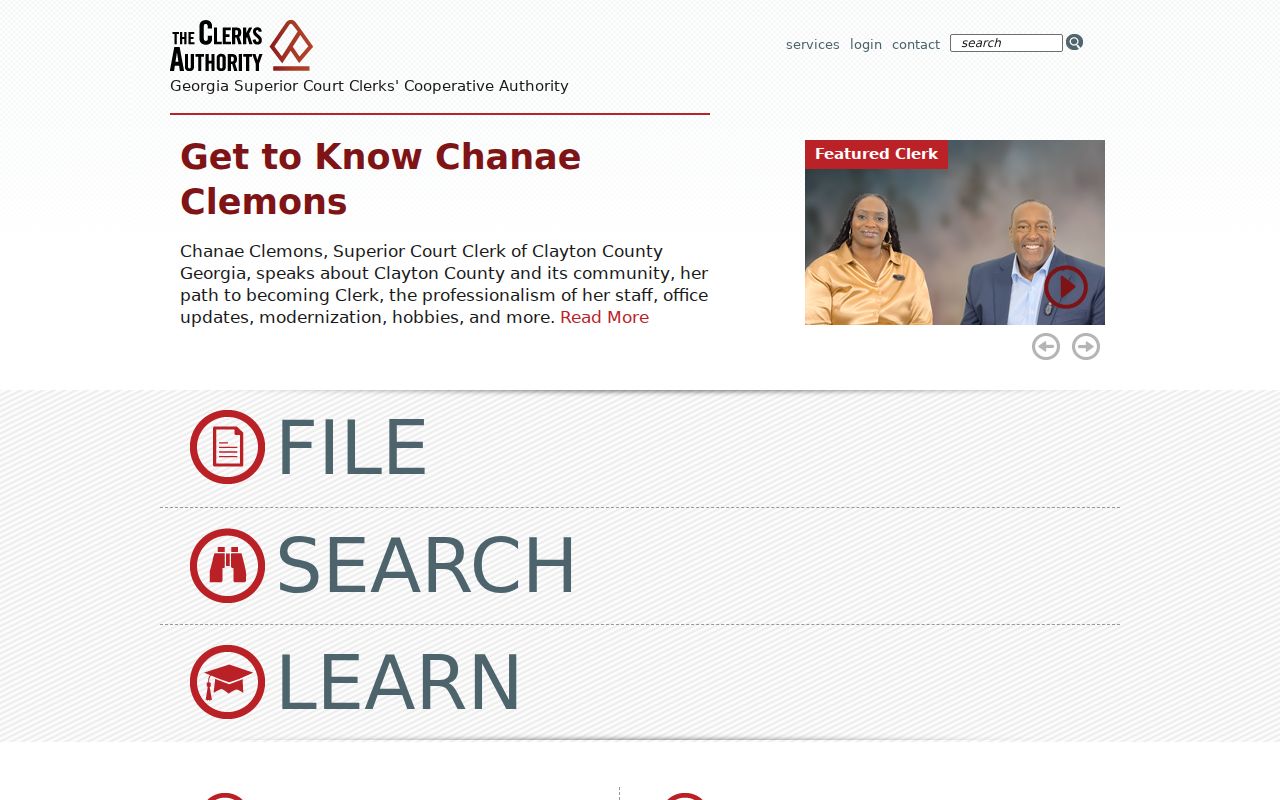
The authority does not displace the Bulloch clerk as custodian of the original county criminal file. Questions about certification, missing scans, archived papers, and local indexing should return to 20 Siebald Street.
Federal Cases Beyond Bulloch Courts
Federal criminal cases connected to Bulloch County do not appear in the county clerk’s trial-court docket. Bulloch lies in the U.S. District Court for the Southern District of Georgia. PACER is the official federal docket search. It requires registration and charges under the current judiciary fee schedule, while sealed documents and protected information remain unavailable.
The Southern District of Georgia website identifies the federal court and its official services.
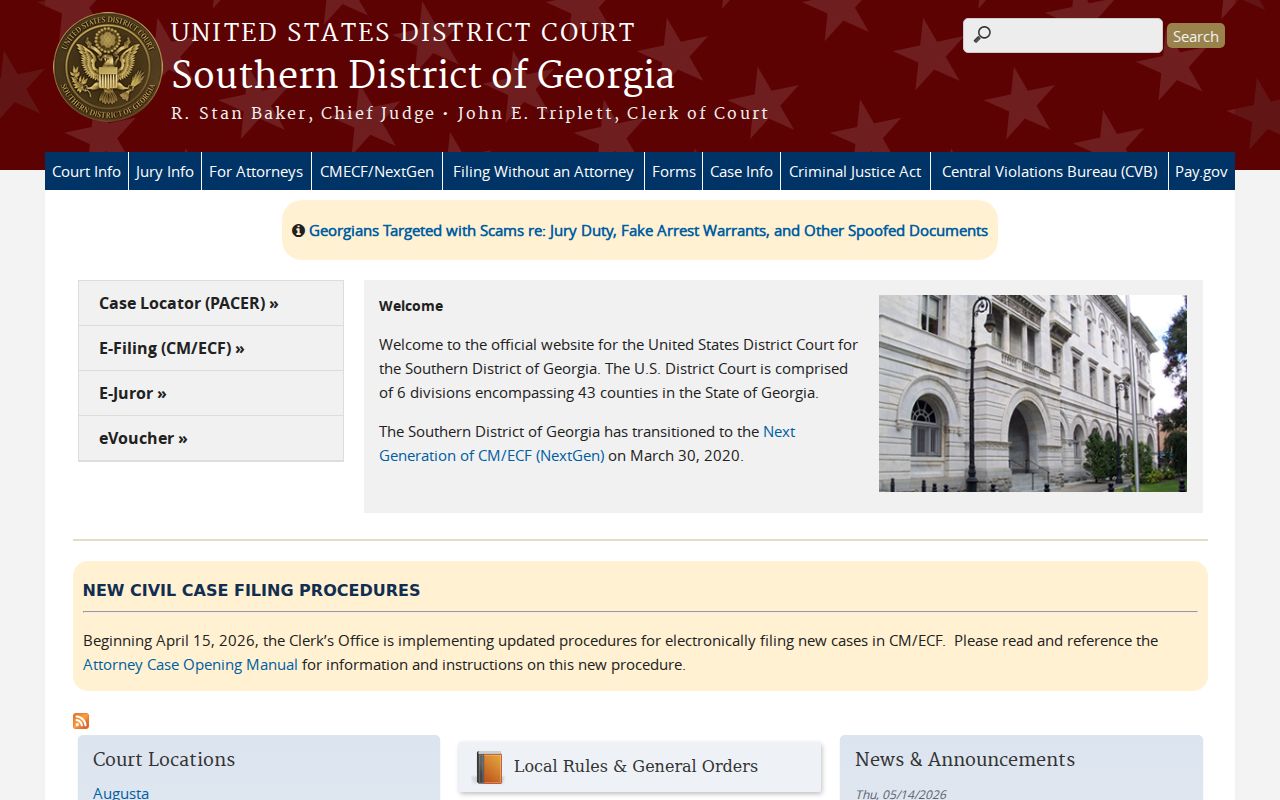
This route is separate from PeachCourt, the Bulloch clerk, and the Georgia Judicial Gateway. Confirm whether a matter is county, state, municipal, juvenile, or federal before treating an empty result as meaningful.
Bulloch Case Record Access Restrictions
The Georgia Open Records Act, O.C.G.A. §§ 50-18-70 through 50-18-77, generally favors access to agency records subject to statutory exemptions. Court files also protect juvenile information, victim and minor data, Social Security numbers, financial accounts, sealed records, and some sensitive attachments. An online record can show less than the paper file, while a lawfully sealed item may remain unavailable in either place.
Georgia record restriction under O.C.G.A. § 35-3-37 limits access to eligible GCIC criminal-history information. It does not automatically erase the public courthouse file. Court sealing is a distinct process when the statute permits it. If a Bulloch case is absent online, ask whether it is archived, non-digitized, restricted, sealed, or indexed under different details. A three-business-day response framework is a response or estimate period, not a guarantee that every file will be produced within three days.
Note: A missing online case is a reason to check the clerk’s index, not proof that the prosecution never existed.